Python Examples
To learn more about Python, check out my open-access textbook Minimalist Data Wrangling in Python.
How to Install
To install the package from PyPI, call:
pip3 install lumbermark # python3 -m pip install lumbermark
Note
For best performance, advanced users will benefit from compiling the package from sources:
CPPFLAGS="-O3 -march=native" pip3 install quitefastmst deadwood lumbermark --force --no-binary="quitefastmst,deadwood,lumbermark"
🚧 TO DO (help needed): How to enable OpenMP support on macOS in quitefastmst?
Basic Use
Note
This section is a work in progress. In the meantime, take a look at the examples in the reference manual and the paper [2].
import numpy as np
import pandas as pd
import matplotlib.pyplot as plt
import deadwood

def plot_scatter(X, labels=None):
    deadwood.plot_scatter(X, asp=1, labels=labels, alpha=0.75, markers='o', s=10)
wut/z2 is an example dataset with five clusters of rather non-homogeneous densities. Lumbermark separates them correctly with no need for further parameter tuning:
import lumbermark
Z2 = np.loadtxt("z2.data.gz", ndmin=2)
lmark = lumbermark.Lumbermark(n_clusters=5)
labels = lmark.fit_predict(Z2)
plot_scatter(Z2, labels)
plt.show()
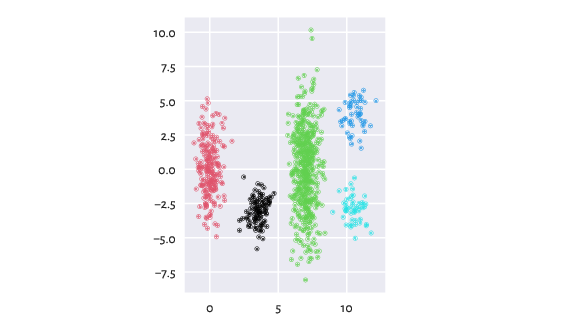
Figure 1 The clustered z2 dataset
Note the scikit-learn-compatible API.
Outlier Detection in the Case of Clusters of Heterogeneous Densities
The recently-developed Deadwood outlier detection algorithm works already quite well in the case of clusters of heterogeneous densities. Still, we can combine it with Lumbermark to detect outliers in each detected cluster separately.
plt.subplot(121)
is_outlier_homo   = deadwood.Deadwood().fit_predict(Z2)
plot_scatter(Z2, (is_outlier_homo<0))
plt.title("Deadwood")

plt.subplot(122)
is_outlier_hetero = deadwood.Deadwood().fit_predict(lmark)
plot_scatter(Z2, (is_outlier_hetero<0))
plt.title("Deadwood+Lumbermark")

plt.show()
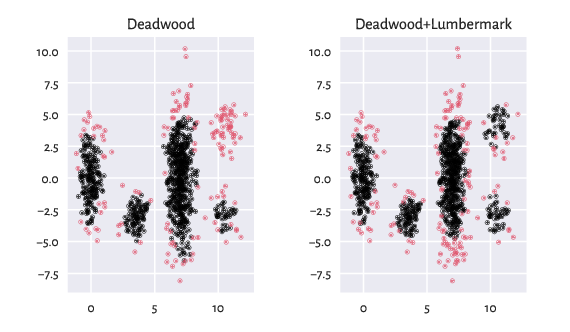
Figure 2 Outlier detection of the z2 dataset
Run Times
Thanks to quitefastmst, the time to perform a cluster analysis is pretty low in spaces of low intrinsic dimensionality.
Let’s conduct a test on a dataset consisting of 1M points in \(\mathbb{R}^2\):
import time
import numpy as np
np.random.seed(123)
n = 1_000_000
d = 2
X = np.random.randn(n, d)
Lumbermark:
import lumbermark
t0 = time.time()
l = lumbermark.Lumbermark(n_clusters=2)
l.fit(X)
print("Elapsed time: %.2f secs." % (time.time()-t0))
## Lumbermark()
## Elapsed time: 1.14 secs.
Due to the curse of dimensionality, processing datasets with high intrinsic dimensionality is slower.
A comparison against k-means (usually the fastest algorithm for small k):
import sklearn.cluster
t0 = time.time()
k = sklearn.cluster.KMeans(n_clusters=2)
k.fit(X)
print("Elapsed time: %.2f secs." % (time.time()-t0))
## KMeans(n_clusters=2)
## Elapsed time: 0.19 secs.
A comparison against Genie:
import genieclust
t0 = time.time()
g = genieclust.Genie(n_clusters=2)
g.fit(X)
print("Elapsed time: %.2f secs." % (time.time()-t0))
## Genie(quitefastmst_params={})
## Elapsed time: 2.10 secs.
A comparison against fast_hdbscan:
import fast_hdbscan
t0 = time.time()
h = fast_hdbscan.HDBSCAN()
h.fit(X)
print("Elapsed time: %.2f secs." % (time.time()-t0))
## HDBSCAN()
## Elapsed time: 12.29 secs.